
Threshing Floor: February 2026

🙦 The word of life: the gospel, and deep wisdom into how it penetrates into the secrets of the heart and the law of this world. Miraculous vision of evangelistic speech act and prophecy. Druidic recreation of the world in Christ. Insight into the future unfolding of providence. The divine mystery of Christ’s body. This word must be behind it all.
Poems: The Little Lead Boy — Cyrus Boyd; Autumn Maple — Elijah Loveland
Story: Invisible Baby — Ava Boyd
Essays: Adult Fiction — Van Fletcher; Disentangling Liberalism — Brian Marr
🙧 Poems 🙦
The Little Lead Boy
On the new kind of road, you can’t see your shoes
	The blurry blues move so fast there, they pull the mist out of your eyes
	Miles lay in piles, and rust, the rush never lets it settle
	If you don’t want to tumble, you’ve got to be heavy
	The updated alphabet has more letters than we have words in our language
	As far as I can gauge, only one has tried to speak that way.
	It won him a journey face-to-face with the alley.
	He didn’t lie, he just wasn’t weighed down.
	So, when they build the elevator first, and the hand rails after:
	I’ll be the little lead boy and you’ll be his father.
Cyrus Boyd
Autumn Maple
Atop a round and rolling hill there stood
Alone an ancient, gnarled tree. Its crust
With nails was pierced and hung about with cups
To catch the life-sap dripping from its veins.
Its earthy roots around were rimmed with blood-
Red leaves, that poured down to the earth from where
its branches were outstretched, and propped with beams
Because they bore a heavy offering
Of umber-burnt, vermillion coals, and sparks
Of saffron flame, and honey-yellow leaves.
While walking ‘round the tree I spotted up
Above an old and hollow wound, some twigs
And straws were poking out and then I knew
Some doves had nested there in spring and now
Were flown across the earth, and where they went,
Had followed life and spring, from this tree sprung!
Elijah Loveland
🙧 Story 🙦
Invisible Baby
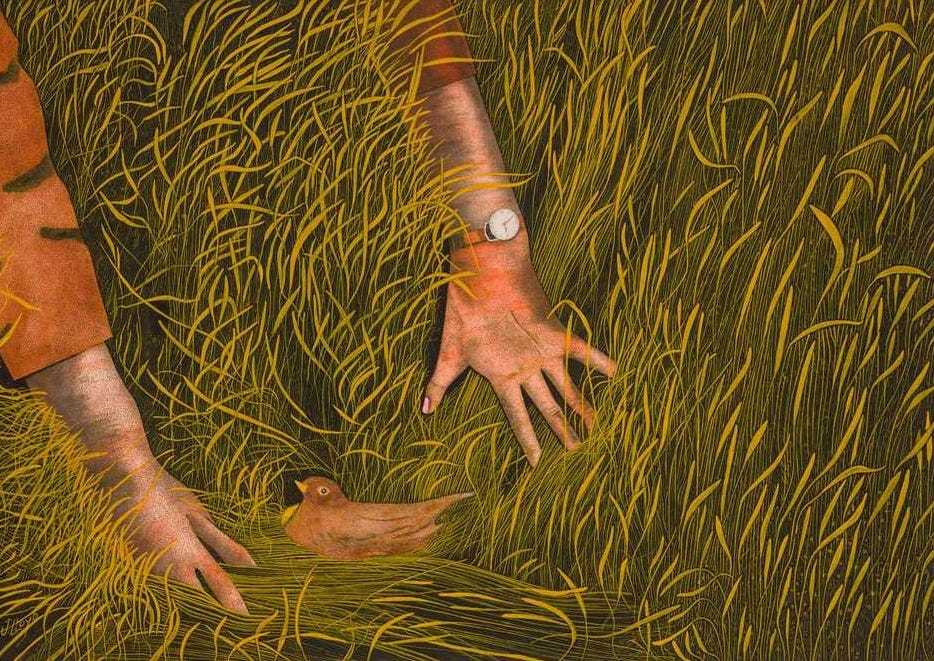
I have to be very careful when walking around the apartment because my husband and I have an invisible baby. Especially now, since he can crawl. Maybe the first time a child crawls is a sweet moment for some parents, but George and I were terrified at this discovery. I’m not an expert yet, but I know parenting was easier when he didn’t move. Luckily, he doesn’t move too fast and I don’t think he can climb yet. I haven’t heard any sickening thumps and subsequent crying, and that is definitely not how I want to find out. For now, the crib is the safest place. My secret fear is that he will phase through the bars and permeate the air. Maybe then I’d smell him and demand he get back into his crib. I don’t know what else I could do.
We named him Ethan. The Greeks and Medievals believed that heavenly things were made of a mystery substance called Aether or Ether. I’m not sure what our baby is made of. It was between Ethan and Gabriel. I thought we’d know once we saw him for the first time. I guess we sort of just knew.
Every ultrasound showed a perfectly healthy baby with a clearly formed spine and working kidneys. These are the only photos we have of our baby, which is upsetting to our relatives in Maryland who can’t make the trip to come and not see him. We bought really nice frames for the prints. They hang in our kitchen, where I can see them best. In the black and greenish-white impressions, you can see he does have a defined form. When he is lost in the apartment, or when he is crying and I forgot where I put him, he feels boundless, limitless. His wails reverberate in the walls and in the air. With each one I sink lower into a pit of guilt, and my arms sweet gently out in front of me as I crouch and coo. My baby is lost in the other dimension. Am I a bad parent?
I do know our baby is beautiful. Almost all babies are. I know he is growing, and that his head and skin are soft. I know his legs are strong and his arms are chubby with five fingers on each hand. I often wonder what he looks like– more like me, or more like George. He should have grown out of the red and puffy ‘newborn face’ by now, and he should have more defined features. I can feel the weight of him sleeping on my chest. I like watching George hold him, his hands cupped over the thin air, tracing the outline of Ethan’s tiny head.
The doctor says that this is just something that happens sometimes. Sometimes the DNA doesn’t work out the way we’d think. Sometimes they form the wrong way, and there is nothing we can do. I think there’s something more than that, because most of the time, his clothes disappear into him as well. I’ve always thought that George has different blood than other people; Ethan could be some kind of spirit, but the doctors won’t look into that. They don’t have tests for that kind of thing yet. They’re not sure if this is something he’ll just grow out of. Maybe if we don’t see his first steps, we’ll be able to see him ride a bike for the first time. But we just have to wait and see. My family says that this is just a reminder that life is full of surprises. Being a new parent is always difficult. For instance, they had no idea I would be so allergic to peanuts! I spent the evening of my first birthday in the emergency room because of a peanut butter cake. I don’t remember that day, but I often wonder what I looked like to my parents— more like a red inflatable baby or a big lobster?
My mom friend, Courtney and her husband Bill have two children older than mine. Both are rosy and visible. Amy and Alec have one beautiful son, Oscar, and are pregnant with their next. Amy and Courtney give me lots of advice on how to raise an invisible baby. We often go on outings hoping that all of our babies will be friends with each other once they’re older. Maybe Ethan will be visible by then. At the park next to my friends, I push what looks like an empty baby swing. I can feel the angry eyes of other moms waiting for their turn with their babies. On walks, old women see my perambulator and ask to see the little angel. I usually tell them that he is very sensitive to light, and I’m so sorry, maybe another day!
One time, Courtney, Amy and I brought our babies to the city zoo to see the animals. I am certain Ethan can see. He is responsive to the colorful toys I show him, and I know he even recognizes me. He makes lots of sounds. He seemed to love the zoo. They had a presentation on bats that day. The zookeeper had skinny legs poking out of his shorts and a huge microphone attached to his face which seemed to throw off his balance. He told us all about echolocation. Bats live in a dark environment, so they perform some sort of clicking motion with their tongue, this helps them to find their way around. The sound waves bounce off of the object and back to the bat. The bat can then determine the object’s form. This could be anything; rocks, food, or their young. Interestingly enough, dolphins can do the same thing. What amazing creatures.
Ava Boyd
🙧 Essays 🙦
Adult Fiction
Why do we consume Adult Fiction?
The Fiction/Fantasy genre (I will use these two terms interchangeably) appeals to adults as well as children, it seems, for many of the same reasons, and a few different.—I will distinguish right off the bat that I am writing about the literary category known as “Adult Fiction”, and focusing on the mythopoetic subcategory, that is to say, Fantasy. This is most importantly distinguished from any categories of adult content, and its definition does not rely on sexually explicit content.—As adults, we already know right from wrong, we understand the real world, and we can see its deep flaws as well as its profound beauty.
Why do we like fantasy as adults, then? Though the formative element of imagination is no longer a required element, we still appreciate the escapist element of Fantasy. As adults, we often seek regress from the strains and pressures of adult life and the responsibilities before us. Sometimes reality is too heavy for us to lift, so instead we pick up Fantasy and commit our minds to fiction. We read Fantasy to feel like we are somewhere else where the same rules as are in real life do not apply. We would rather here a story about someone being freed from the bonds of reality and transported into a fabulous or extraordinary world so that we too may have the sensation of being in that lighter, easier to handle world. Make it fantastical! But not too fantastical, please, I do still want to be able to believe it for a time. In fact, why don’t you make it fantastical enough for me to feel like I am in a different world, but also tell me the things I know about the real world. I find that it is too light, why don’t you add a bit mor weight so that it might feel real when I read it.
What is the real world like? Well, it’s like me of course! I am a real person after all. And what is reality? Well, it’s what I see all around me in the real world. Darkness, evil, brokenness. Injustice runs amok and there’s not really anything we can do about it, so why not show me a world much like this one, where good does not triumph and darkness is as prominent and unchangeable as light. Let the children read of slaying dragons, let them believe there is good to be fought for! We, the adults know the truth! It’s all Hell.
This train of thought is what has founded most of today’s Adult Fiction literature. Fantasy is imaginative, and imagination is childish, so since we are not children any longer, we cannot indulge in childish things. We must make our fantasies less imaginative, make them heavier and more realistic, as we know what real things are, and must have something closer to that so we may still believe the fiction.
Most adults who read Fantasy are escapists. Most adults who write Adult Fiction are escapists. The desire to escape the real has sprouted from the painful understanding we have gained about the broken world around us. We can no longer believe in good triumphing over evil, because we have seen in the world around us that it does not. We can no longer believe in a standard of morality because those people who decided upon a moral standpoint were themselves immoral. Our inability to believe in something good leads us to seek an escape, but when we seek to escape, we seek to escape into something we can believe, and all we can believe in is the predominance and constancy of evil. We escape into a world as bad as our own and revel in it, believing it to be better, merely because it is different from just the way we are used to looking through the window. “If you need a change of scenery for a while,” they say, “look at the room through a mirror.” But evil in the mirror is still evil, however more interesting it may look…
Van Fletcher (You'll be able to read the rest here.)
Distentangling Liberalism
As race wars and sexual dysfunction increase in modern American society, the values that we took for granted are now on trial, deemed inadequate for an America entering a post-religious age.
Among the casualties of cultural decline, “liberalism” has come under attack, but under that word lies several related and overlapping meanings that need to be disentangled.
In what follows, I will untangle five of those liberalisms, rendering judgment as I go.
Radical Individualism
The first and most pop-level understanding of liberalism is also the least morally defensible. This version of liberalism considers the greatest good to be individual self-actualization. The individual creates his own values, and as long as his values do not impinge upon others, he is free to develop himself as he sees fit.
There is no natural law here—individuals are for all intents and purposes their own law. There is no set of objective goods above the individual that allows society to critique them or exert social pressure on them.
This view is radically anti-Christian and anti-human. Not only is it an assault on the created order, but it leaves people orphans with no guidance in life or even anything to aim for. Radical individualism is nihilism cleverly marketed as freedom.
Secularism
The precondition for radical individualism is secularism—the idea that the purpose of government to determine whether one individual has impinged upon another’s autonomy. This displaced the older idea that the government enforced a morality rooted in reality, the nature of the world, and the truth about God.
In the nineteenth century, the basis for public morality was thought to be natural law. The enlightenment project was an attempt to come up with an understanding of ethics based on self-evident consensus about what is good and bad for human beings. After the fifties and sixties, this consensus dissolved and the state was reduced to an umpire negotiating over a game of Calvinball.
A shared morality is necessary for a nation to maintain stability, and this morality has always been rooted in a transcendental God whose claims are greater than our whims. A nation that is able to pick and choose its morality is a nation that will never endure hardship or defend itself from its enemies.
Libertarianism
After the cold war, Americans got the idea that the purpose of the state is to safeguard the liberties of the individuals, and that any coercion beyond a bare minimum of national defense and punishment of crimes is tyranny. For political reasons, conservatives in the United States have opted into this view as much as liberals.
Libertarianism rests on the assumption that individuals do not share a common social space or limited goods. Mainstream libertarians have recognized a set of commons with regard to policing and the national defense, but they have often neglected to consider this same principal with regarded to limited resources like land and all sorts of other commons. The government should ensure that the commons are not monopolized and that no group has a disproportionately negative effect on the nation as a whole.
The government exists to promote virtue among the citizens, which means considering the social conditions that shape and mold the people’s character. Obviously, the government should intervene in the spheres of business, church, and family rarely and only for great cause, but it remains the duty of the ruler to ensure that social conditions help promote virtue rather than vice.
Social Contract Theory
Prior to the modern era, political philosophers agreed that fathers, magistrates, and kings did not require the consent of the subjects for their decisions to be binding. Contrary to the declaration, power did not derive itself from the consent of the governed. The father had his authority over his wife and children by virtue of being their head. He might abuse his authority and forfeit it, but he wielded it by default.
Today, by contrast, we think people have to endow their rulers with power to legitimize their authority and the prerogative to take it away as they see fit. The problem with this theory is that it assumes that individuals come into the world free from social ties, which is utterly opposed to our lived experiences. Children are born into a world with parents, and it is through their parents that they inherit a culture, a speech, and obligations.
To think of such authority as always needing consent undercuts social ties and has contributed to our increasing social atomization.
A Cheer for Liberalism! Liberty of Conscience
Thus far I have been talking about bad versions of liberalism. There is one that I like though and it centers around liberty of conscience.
In liberal societies, no one is forced to affirm something they believe to be a falsehood. This value was a hard-won liberty that came from Protestant political theory, and it was the soil in which freedom of assembly and freedom of speech arose. A commitment to free thought does not commit us to something like universal suffrage or citizenship, but it did allow the development of a healthy civilization in the United States.
The value placed on the individual and the removal of barbaric practices such as crucifixion, drawing, and quartering is one of the great triumphs of the last few centuries, and while there is much under the name of liberalism that is worth discarding, Christians should indeed be loath to throw away all that our fathers have built.
Brian Marr
🙧 Elsewhere 🙦
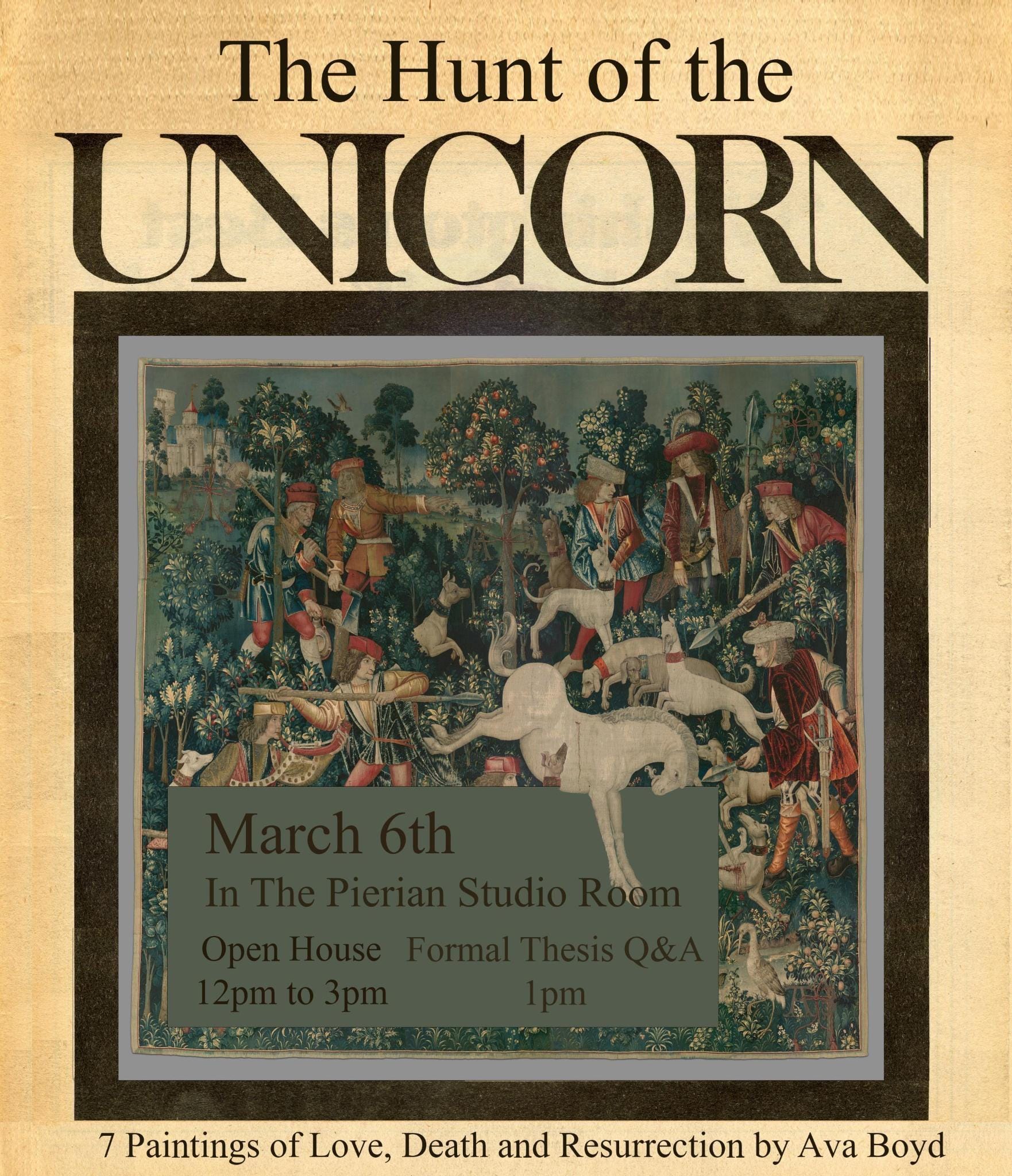
Ava Boyd is having an open house for her thesis series of seven unicorn paintings at the Pierian Gallery. Inspired by the medieval unicorn tapestries, they are original compositions that incorporate modern motifs.
Moses Bratrud shows you can still read.

Van Fletcher is launching a substack.
🙦 Word of the forest — culture and memory. Words to call the ruins of the past back up and enjoy them. Otherwise our mind becomes cluttered with the present ugliness. Noise of desolation and our anti-culture of death must be overcome with a slow growth forest made of thousands of scattered seeds, old treasures, new.