
Threshing Floor: January 2026

🙦 The sympathies: striking good valences through — seasonality, (micro)scope and the birdshot diaristic, womanly sensitivity of cosmic dualities, kinetic mirroring, deep wish, the deep gravities, the analogy of biography and biopsychic unfolding…
Poems: The Magi — Van Fletcher; Rat Invasion — Catharine Gildner; Letter to a Dead Great-Grandfather — Maria Hanson; Jesus in the Reeds — Michael Thomas Jones; Untitled — Gascan Nithril; I Can See the Cascades from Here — Joffre Swait
Essay: The Light Shall Not Be Darkened — Angel Warner
Song: Paper Moth — Vegas Harmon
🙧 Poems 🙦
The Magi
Upon the world the cloak of night was laid,
And ev’ry tribe was wrapped within its fold
Before the heavens split and earth was made
To marvel at the wonder that was told.

To shepherds first the Savior was made known;
As to the man and wife at Garden’s door,
And light upon all those in darkness shone,
Who only serpent’s wiles had known before.

But wester, high in heaven rose a star,
Foretold by prophets; pagans now could see,
And from the east, from palaces afar,
To Jewish lands then came the magi three.

In Herod’s palace, ‘fore the king they stood
And asked him where the child, the king, might be;
And spoke they of the star they understood
To be the sign of royal infancy.

“In Bethlehem,” was given the reply,
“The city of King David’s royal line.”
“But tell me,” said the king, that monarch sly,
“Who is this child? When saw ye first the sign?”

“Full two years, lord, this star held heaven’s field,”
Said Melchior, first, to the Jewish king.
“And we have made a journey long to yield
Unto this infant homage, and to bring

“Unto this child our gifts as we find meet;
I gold have brought from Persia’s treasure hoard.
For such befits a king in regent seat;
Who all shall rule, who o’er us was born Lord.”

“And frankincense; a holy gift, I bear,
Whose sweet aroma warrants such a child;
For priest he is, a judge both just and fair.”
This Caspar said, the second magus mild.

“I read” said he, “upon th’ eternal dome
That one has come who is the Sacred Way;
Who holy is, and holy shall become,
And shall the world’s sins then take away.”

Then Balthazar, the last, reserved and dark,
Before King Herod came and offered peace.
An ebon box he bore, both black and stark,
Then opened it and, solemn, said his piece:

“My gift is myrrh, by heaven dark revealed,
With which to ward off vapors of decay.
The stars have spoken from their lofty field:
The child must die. It is the only way.

“For only evil dwells within man’s heart,
And death our meet, who come from earthen womb.
A prophet is this child, beyond my art,
And shall a prophet’s end meet, and the tomb.”

Then all in silence stood, and pondered well;
For to each magus different reed was shown.
The star that wester rose the truth did tell
In part to each, that full was now made known.

And so they left King Herod there to brood,
Continuing their westward journey far.
Who first knew little, now all understood,
Rejoicing when at rest they found the star.
Van Fletcher
Rat Invasion
Moths mustily shimmer out
A dour and dusty defense,
And blink sweet-winged eyes at you,
You who’d kill the pope for a taste of incense.

Yes! You! You crusty little Godzilla.
No one likes you (at least not me).
There are scars on your cheeks,
And a growling, grunting

Grasping, groaning
Gurgling in your throat,
From stolen goat’s milk draining down
Into your hollow, langly toes.

Invaded again,
by a barking, bellowing smell,
I—no, you—crankle my nose—oh no!
Your secret’s been given away—
Shame! Shame! Shame!

Everything is realer at 1:42.
Claustrophobic feet, hieroglyphic sweat.
Under a carpet in Romania,
There’s a stain creeping, seeping sepia red.

“I’m dipping my toes into a red dirt world,”
Says the raised-eyebrows man.
With engine grease all in his poetry,
He’s a foreigner, homeless, with a walnut tan.

The pipe turns left-ways up,
A squirt of steaming water flies,
Chunks of yesterday’s hot pot roast,
And two gleaming, death-red eyes.

Stealing secrets, sleeping in grease,
There goes a fat-bellied emperor of the drain.
Tremble, you Rat! My closest enemy.
I hope you feel every last gut-boiling pain.

Then we smelled a smell that I’ve smelled before.
Terrible, twisting, tearing my eyes,
Floundering, flailing, flinging the past
From where it should be, to here, now—it dies.
Catharine Gildner
Letter to a Dead Great-Grandfather
I have your wife’s hair,
I noticed today,
Looking in the mirror.
And then a flash

I am a little girl stood at the sink
Tip-toe:
I’ll be this tall soon–

Now I am all at once standing
In the midst of a life
(Tall as I’ll ever be)
And I can just barely hear you anymore.
What I do hear is out of place
Like that bird caught
In the supermarket.

So ride that cherry-picker to the moon, Eugene.
Find God among the fig trees growing there.
Maybe up close
You will realize those Missouri thunders
Could have only ever been
The voice of God.
Maria Hanson
Jesus in the Reeds
This man sneaking onto my property.
slipping through the shadows of the river.
a knife in moonlight.
a pale shirt soaked through.

but see
the light through
the secret glass
casts the circular
map of the time cycle
upon the cavern's smooth
stone floor, where it rotates slowly.
a bitter medicine thrust into
my mummified mouth by unclean fingers.

an iron argyle worm
stretches out
of grandfather's silver
pocketwatch.

hurry and find
bird island,
in the bay of paint.
before strangers
come and take it away.
Michael Thomas Jones
Untitled
Ew
A man without socks
Barefoot in a leather shoe
Can you imagine the stinky toe stew
Ew
Gascan Nithril
I Can See the Cascades from Here
With gratitude for the gratitude of Austin Anderson, Will Boyd, and Hugh Powell.
Postcard hills roll past us uniformly,
Waving wheatly as they wind their highways
Over gentle swells, through tiny valleys.
Tucked between the leaping crests and cleavage
Plunging where naturally the eye would flow,
Pools of people gather in basin towns.

Milkers these are, like ants on aphids, stroking
The land until she droplets squeezed grain
From out her mounds, round after round, outrippling
Rank on rank, the rolling waves outgang,
Each a glory, a glory, each a glory,
Each somehow the same, a glory, a postcard.

We drive setwise, kingfisher in and out
Of little clefts and hamlets, hidden towns.
West of Palouse an impossible valley appears.
Between each breast it’s cooler, more varied the life:
Whitebarked birch and sunbright yellow aspen,
Weeping willows sweeping wooded waters.

We’re now past Colfax Airport, at world’s edge,
Lentils end and cataclysmic Scablands begin.
We crest, and I can see the Cascades from here,
Snowcapped in May, beyond even the ranches
And cherry branches of watered sagebrush steppes.
Joffre Swait
🙧 Essay 🙦
The Light Shall Not Be Darkened
Darkness spreads its heavy velvet mantle early on winter evenings. Blackening windows mirror the activity of life sheltered inside from the cold. Inhabitants isolated inside move through their evening routines unaware that the light which illumines their mundane tasks engages in a valiant struggle against the enemy outside. It must push back the shadows.
I have a fascination, perhaps due to my wistful nature, with medieval monastic communities. This is no romantic fascination of the sort that longs to live as they did. Rather, it can best be described as a deep respect and wonder at those who did choose to live this way. Opting for a simple, even brutally spartan life is not something we moderns can readily understand or appreciate. Yet, I have an ever-growing gratitude for the rich inheritance we have received as the result of their choice. Their self-imposed isolation and impoverishment have given the world riches beyond imagination.
In the 6th century a monastic community was built on the inhospitable Skellig Islands jutting violently out of the Irish Sea. It was on the larger of the two islands, Skellig Michael, that the monastery was built on a cliff hovering 600 feet above the crashing waves. Higher up, at 700 feet, a hermitage was built as a place where one could pray in as close physical proximity to God as possible. Monks lived in tiny little bee-hive shaped stone huts called clochans. In an effort to keep out the harsh weather the only opening was a skin-covered door. The brothers here spent their days in quiet study and prayer. They also spent many isolated hours painstakingly copying the holy Scriptures, histories, and the literary works of classical antiquity which had been carried up to these remote regions by the invading Romans. It is possible, even likely, that the great canon of Western literature known to us as “The Great Books” would have been lost forever when the hordes of so-called barbarians swept across the European continent in the years following Rome’s demise. Rather…in little stone huts and cold stone cells in the British Isles, men who chose obscurity as their way of life conducted their work by the weak flicker of candle flame preserving much of our heritage. Most importantly, they were preserving God’s Word which would kindle much brighter flames in the years to come.
One of the harsh realities during the early Middle Ages was the constant threat of Viking attack. Britain was an easy mark for the marauders, but even the harsh conditions of the Skellig islands were not enough to deter the Scandinavian invaders whose native lands were equally harsh. There are at least two specific Viking attacks recorded in histories of the eighth and ninth centuries. In the first, the island was invaded and the Abbot was kidnapped and left to starve to death. In the second, the famous Olaf Trygvesson, invaded and–in one of the great twists of history–was baptized by one of the Skellig brothers. Olaf took his new found Christian faith and the mandate to spread it very seriously. Unfortunately, Viking-style evangelism often included torture. For those who failed to accept the faith and be baptized, it often led to death. At least in the early years. Over time and with patient instruction Olaf, King of Norway, laid aside his cruel ways and the Viking culture was conquered through the cross. The monks of Skellig, living in isolation from the rest of the world, had been used by God to plunder the kingdom of darkness in northern Europe.
The monastery was eventually abandoned. It became home to two lighthouses, steering seafarers away from the dangers hidden by the cover of darkness. These, too have now been abandoned. Yet, the light from Skellig has not been extinguished. All the brothers had hoped to do was live faithful lives of quiet devotion engaging in the seemingly mundane task of copy work. Were they ever aware of the valiant struggle that their little candle-lit huts were waging against the enemy outside? The end of their light, of all light, is to push back the shadows.
What quiet tasks are we performing in isolation that are helping to push back shadows? Are we content to have them known only to God? May the long winter nights ahead give us the time to reflect on these questions.
Angel Warner
🙧 Song 🙦
Paper Moth
Vegas Harmon
🙧 Elsewhere 🙦
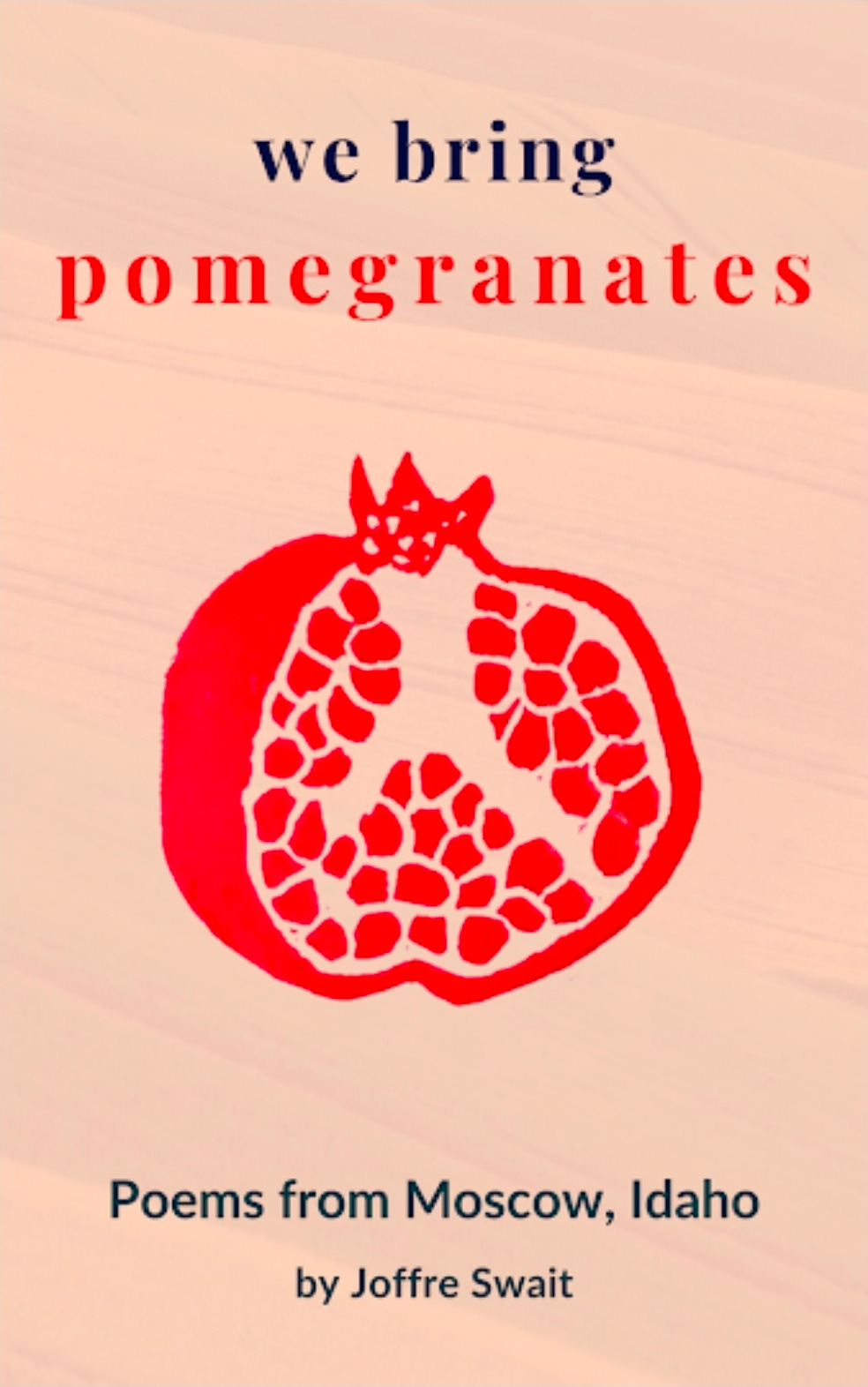
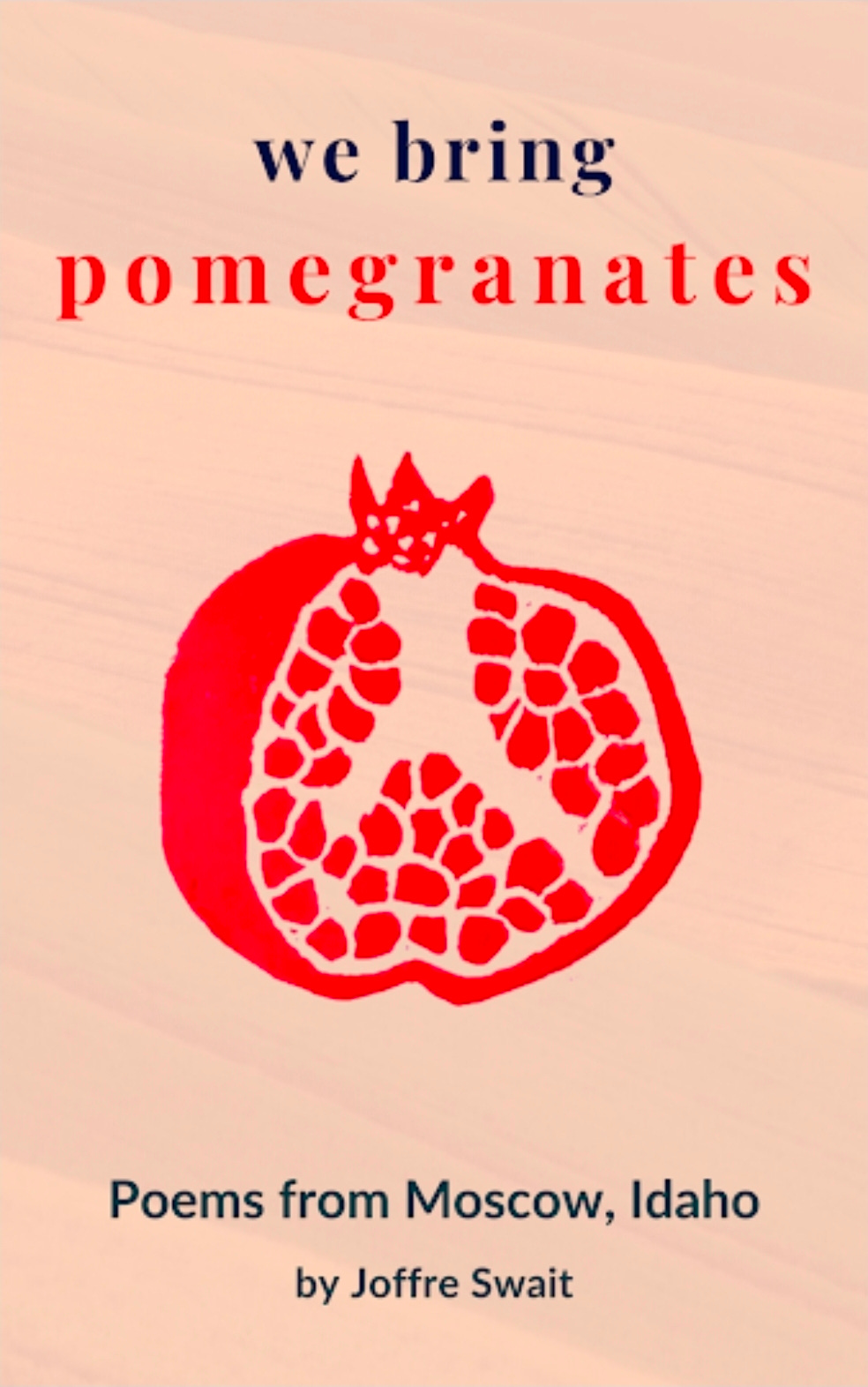
Joffre Swait has released a book of poetry: We Bring Pomegranates. You can review the book release announcement as well as the post announcing the audiobook. You may find the book on Amazon.
“This book is the fruit of my prayers and labor in the town of Moscow, Idaho. Each poem here collected meets two criteria. First, it was directly inspired by a sermon, conversation, or sight that imposed itself upon me during my sojourn here. Second, it is either about Moscow or makes me think of the labor of God’s saints in this town.
There is a great work of generational evangelism taking place here, and it turns out that it is worth writing about. In fact, this is a great town in which to be a Christian and an artist; if you are such a one, pray about coming to join our gracious construction project.” - Joffre Swait, from the Introduction
“This volume of poems are the fruit of Joffre’s own wrestling with words. He offers to you, as his reader, the fruit of those reflections in poetic dress. So notice the progression: the preacher wrestles with the Word, the poet hears and receives the word and wrestles with it himself, and now, you yourself are invited into the arena to wrestle with these words also. True sons of Israel always wrestle, and if they do so in faith, they come away blessed by Jehovah’s Word.” - Ben Zornes, from the Foreword
Catharine Gildner has been regularly posting on her substack with great poetic work.
Likewise Simeon Landis with great cartooning.
And the editor with deranged essays…
🙦 …a character’s extreme love of honor, with occasional kingly vastness and loftiness of a great artist and extreme symbolism moving way up beyond their expected sympathies and building a bond with a transcendent one. You can’t run roughshod over these things without going insane and losing everyone’s sympathy.